Artist's Statement
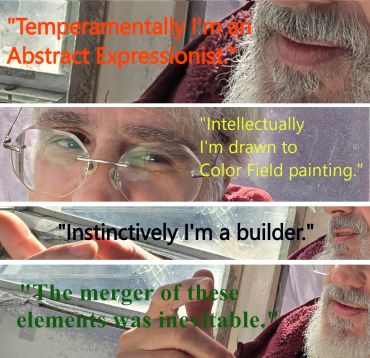
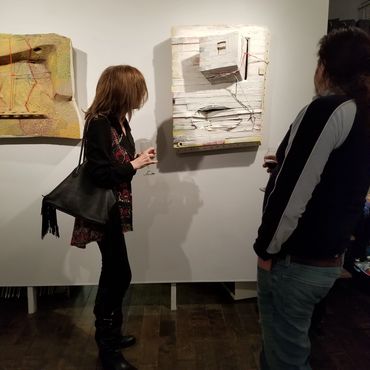
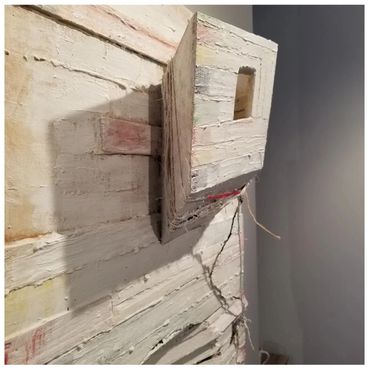
I make three-dimensional abstract paintings with heavy textures and vigorous brushwork. The paint is acrylic and typically the forms are constructed with wood and covered with canvas. These paintings are a response to the limitations of art’s traditional 90° corners and two-dimensional format and smooth surfaces. My first explorations beyond old boundaries were a temperamental impulse more than an intellectual endeavor. But as my work progressed, the mind caught up to what the hand was doing and the process shifted from spontaneity to deliberate action patterned after prepared drawings.
When I began to paint in the early 1980s, I considered painting’s historic timeline to be like a relay race, and I was being passed a baton from the Color Field movement and therefore responsible for advancing that baton down the track. Modern day viewers might not see similarities between my current paintings and Color Field paintings of the 1960s and 70s, but they should remember my race has been progressing for more than 40 years, and Color Field was simply the starting point.
Care to learn more? Read on
A carpenter believes his son should learn a trade, so he brings the kid to the jobs. Having lived through The Great Depression, poverty, and WWII my father was a serious man. I drove him nuts. For me, someone with an innate passion for history and archaeology, the job sites were a cornucopia of visual delights—old buildings, churned earth, piles of rubble, and paint; layers and layers of old paint. The paint was like archaeological strata, like levels of occupation. If a wall was painted when it was new, how often would it have been repainted? How many layers do I detect? How old could this wall be? What was life like for each generation that lived within these walls?
My interest in paint was not an interest in color, rather an interest in the material. I was fascinated by the stains and scuff marks on top of paint and how layers below the surface could be easily observed. I loved the chips and gouges which allowed inspection of lower layers. I was fascinated how lettering and numbers painted on a truck got overpainted yet remained visible.
What I really liked was the rubble, the painted walls broken into chunks. Here paint became an object. A person could walk around a color. I liked how the paint was framed by the broken edges and colors of shattered masonry.
In the early days of my abstract painting, I painted over the previous year’s representational paintings—the old landscapes, still lifes, and figures. I added textures to the paint, like sand for example, and began to embed odd and miscellaneous objects. All this happened instinctively. It was only about a year later that I became fully aware that I was replicating the scenes of my childhood on construction sites.
A Philosophical Approach to Painting
A drawing line. A brushstroke. A drip or a splatter. All these are evidence of human activity. All of these are a surface activity upon a colored field. I consider the application of paint as a symbol for all human endeavors and the layering of paint as an analogy for the passage of time that can be read like archaeological strata. Each level represents a period of occupation like a city built over the remains of previous dwellings. Thus the cycle of life is illustrated in my paintings which mimic construction sites and the repurposing of locations and materials. An additional symbolic feature is created by protruding three-dimensional features which cast shadows like a sun dial marking the passage of time.
Final note: The Process
It takes time to build a painting. My brain is hyperactive and my hands can not match the pace of new ideas. I sketch out an idea and that sketch inspires dozens of variations on the theme. Eventually this series morphs into a new series. And that one into another. They all share the same DNA, and a family resemblance is detectable, yet the individuals can look quite different. Because ideas arrive so fast and abundantly, I can’t physically produce all the paintings, so I chose one or two from each series to make and move on.
Currently I am trying a new approach. I have a massive series of still lifes sketched out and am in the midst of creating a complete series. I plan on doing the same with the abstract work. Two series are in the final selection process and the production of just one will soon commence.
Paul Genader